
Free Access to QNX Hypervisor with QNX Everywhere
QNX has made the QNX Hypervisor, used in millions of vehicles and embedded applications worldwide, free for non-commercial use through QNX Everywhere.

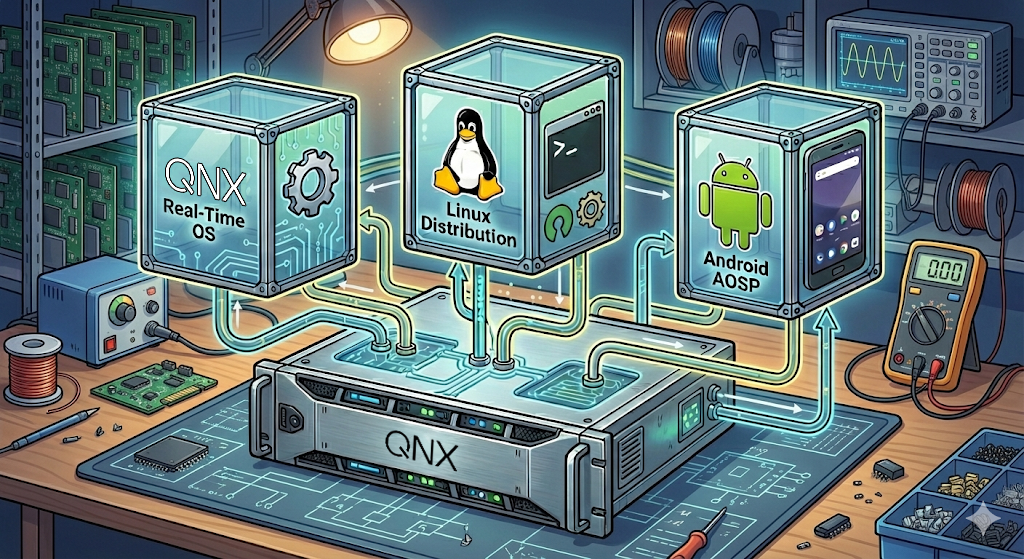
QNX is pleased to now include our QNX Hypervisor 8.0 product in the already-available free non-commercial QNX Everywhere developer license. If you have a free license already, you have access to it now. If you don't have one, you can get one easily at qnx.com/getqnx.
A hypervisor, also called a virtual machine manager (VMM), is software that abstracts the system's hardware in such a way that an operating system can host one or more virtual machines (VMs). These VMs provide environments in which any operating system and its applications can run. These VM environments are known as guests.
Here's a more concrete example (that you can set up and try today!). You get yourself a Raspberry Pi 4B, and create an image running QNX 8.0 with QNX Hypervisor. As part of the image, you include two more guest images: one for a second instance of QNX, and one for an instance of Linux.
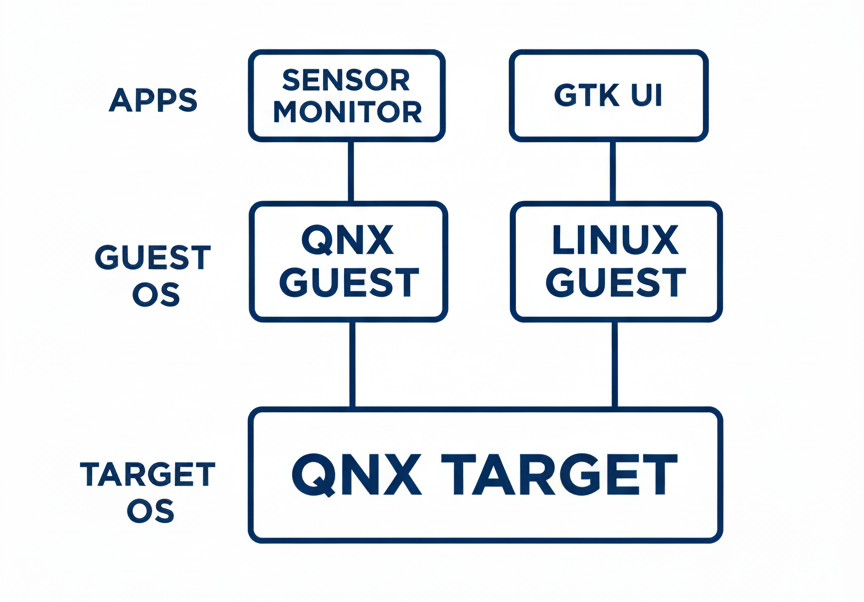
When the image starts up, you now have three environments for running applications: the base QNX target, running Hypervisor; a second QNX OS instance as a guest, which could run applications requiring real-time deterministic performance; and a full Linux OS guest environment, where you might run a user interface with something like GTK or Qt. All this running on one board.
QNX Hypervisor in the Wild
QNX Hypervisor is relied on in millions of embedded applications around the world every day. Your car’s infotainment system, advanced driver assistance, and safety-critical controls can all run side by side—without stepping on each other’s toes. That’s the magic of the QNX Hypervisor. It’s like the ultimate traffic cop for your embedded systems, orchestrating multiple operating environments on a single piece of hardware. Instead of juggling separate processors for every function, you consolidate, streamline, and keep everything humming in harmony. The result? Lower costs, less complexity, and a platform that’s ready for the future of connected, autonomous tech.
So Why Does it Matter?
Modern vehicles and IoT devices aren’t just gadgets—they’re ecosystems. The QNX Hypervisor gives developers the power to isolate critical workloads while still enabling rich user experiences. Think of it as virtualization with a safety-first mindset: secure partitions, deterministic performance, and the flexibility to run Linux, Android, and QNX side by side. It’s not just about saving space; it’s about building smarter, safer systems that scale.
There's also resource scarcity: with pressure to reduce the silicon in embedded products like vehicles to reduce cost and simplify supply chains, products like QNX Hypervisor allow you to do more on a single ECU.
Try Hypervisor Yourself
More advanced QNX users with some experience building images or using QNX Hypervisor can jump straight to the QNX Hypervisor User's Guide.
For the rest of us, we've created a repo with a sample Hypervisor configuration that runs on Raspberry Pi 4B. You can try it for yourself, tinker with the settings, and host your own guest operating systems! Can you get AOSP Android running on QNX?
Getting Help
Lastly, if you want some help with your QNX journey, you can find the QNX team and community:
- in Discord here: discord.gg/Jj4EkkrFTT
- on Reddit at: reddit.com/r/qnx


